Maintenance
Ferry trip mistakes: first principles as of 2027
The ferry mistakes that cost real money and real days, why the ocean drives the weather that causes them, and where reliable marine information comes from.
What to take away
- Almost every expensive ferry mistake is a timing mistake wearing a different hat.
- A missed last sailing on Washington State Ferries' Anacortes to Friday Harbor route can mean an unplanned hotel night, typically $150 to $300 in summer.
- The ocean drives the weather that cancels sailings, which is why a land forecast is the wrong instrument.
- Marine safety information is broadcast through dedicated channels that do not depend on your cell signal.
- Treat a cancelation as a safety decision made by people with more information than you have.
The eight mistakes that actually cost something
- Booking the last sailing out.No fallback, and a cancelation becomes an unplanned night.
- Reading the town forecast.The water two miles offshore behaves differently from the seafront.
- Assuming the timetable is fixed.Seasonal changeovers catch out travelers every shoulder season. Most North American operators switch timetables in late spring, typically the second week of June, and again in early autumn, often the week after Labor Day.
- Building a chain with no slack.Two ferries and a flight in one day is a plan that fails on schedule.
- Ignoring the walk at the far end.A cheap crossing to a landing five miles from anywhere is not cheap.
- Trusting a card machine.Coastal signal drops take payment systems with them.
- Arriving at the ramp without the tide times.On tidal routes this changes the boarding and the walk.
- Arguing with a cancelation.The decision is not a customer service position.
Why the ocean is the thing to watch
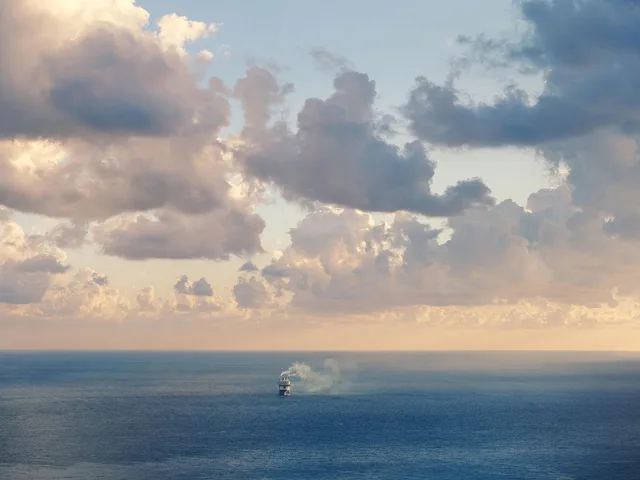
A marine forecast beats a city forecast for a structural reason. For a passenger, the practical habit is to read what the water is doing, not just the sky above the hotel. NOAA explains that the ocean shapes climate and weather patterns: warm ocean waters provide the energy that fuels storm systems.
Town forecast vs marine forecast
Town forecast
- What it describes
- Sky above your hotel
- Key variables
- Air temperature, rain
- Who uses it
- General public
- Traveler habit
- Check before leaving hotel
Marine forecast
- What it describes
- Water two miles offshore
- Key variables
- Sea state, open-water wind, swell
- Who uses it
- Ferry operators
- Traveler habit
- Read before every crossing
Sea surface conditions, wind over open water and swell direction are the variables an operator weighs, so they should be the variables you read. Check the marine zone that covers your route before you book. The zone name is often on the operator's website.
Where marine information actually comes from
Marine weather reaches vessels through dedicated channels rather than through apps. The National Weather Service's radiofax program prepares high seas weather maps through four U.S. Coast Guard transmission sites at Boston, New Orleans, Point Reyes and Kodiak, plus a Defense Department site in Honolulu.
For a specific area, open the NWS marine zone forecast, such as PZZ135 for Puget Sound and Hood Canal, or the Ocean Prediction Center's Atlantic and Pacific high seas forecasts.
The products come from the Ocean Prediction Center, the National Hurricane Center and the Honolulu and Anchorage forecast offices. The same page notes that NWS marine forecasts rely heavily on voluntary meteorological observations from ships at sea.
Two things follow for a traveler. The information an operator uses is a professional product with a chain of custody. A small battery radio is genuinely useful kit on a route where coverage fails.
Fixing the mistakes
| Mistake | The fix |
|---|---|
| Wrong forecast | Read the marine zone product |
| No slack | Keep one full day, 24 hours, before anything fixed |
| Ignoring the far end | Ask what meets the boat |
| No cash | Carry small notes |
| No tide times | Four minutes the night before |
| Arguing | Ask about rebooking instead |
Write your fallback plan before you leave
Write the fallback down before you leave: where you sleep and what you do if the crossing does not run. It takes five minutes at a kitchen table. You cannot do it well standing at a ramp in the rain.
Use four lines: the last sailing you will accept, the backup crossing tomorrow, one place to sleep near each terminal with a phone number, and the amount you will pay to rebook without arguing.
Build that into the wider sequence in our ferry trip planning guide. Read the coastal version of the same errors in our first-visit coastal tips.
Common questions
What is the single most common ferry mistake?
Can I appeal a cancelation?
Do operators warn in advance?
Is travel insurance worth it?
In this guide
- Ferry trip mistakes field guide: 4 deck photo tipsFerry trip mistakes field guide to deck photography, with advice on waves, safe deck positions, route planning, shutter choices, and salt-spray protection.
- Ferry trip mistakes compared from start to finish, updated for 2027Ferry trip mistakes compared from start to finish, updated for 2027 explains how operators decide, notify and refund when weather turns marginal.
- Sheltered stops that rescue a ferry day when plans fall apartSheltered stops that save a canceled ferry day, from named lagoons and mangrove boardwalks to harbor towns and quiet coves worth the trip either way.
- How to build slack into a ferry trip so a wrong guess stays survivableA guide to building spare days into a ferry trip, with one crossing a day, plus how marine safety warnings reach ships and what a seiche is.