Features
Part of How to avoid ferry trip mistakes in 2027
Ferry deck photography: the mistakes worth avoiding
Common errors when shooting from a ferry, how waves actually work, and how to read significant wave height so you know what the deck will do.
What to take away
- Waves carry energy, not water, which is why a deck moves the way it does and why shutter speed matters.
- Significant wave height is not the height of the biggest wave, and knowing the difference prevents bad decisions.
- The most common deck photography mistakes are physical, not artistic: dropped gear, salt, and blocking a walkway.
- If the sea state is genuinely rough, put the camera away. Holding a rail beats holding a lens.
The mistakes people make on deck
- Standing where the crew works. Ramps, mooring stations and stairwells are not viewpoints.
- Shooting with a loose strap. A camera over the side is not recoverable.
- Changing lenses outside. Spray and sensors do not mix, and the wind chooses the moment.
- Slow shutter speeds on a moving vessel. Engine vibration and swell both add motion you cannot see on a small screen.
- Forgetting the return leg. The light that failed outbound often works coming back.
- Ignoring the safety briefing. It is short, and it is the one thing on board that is genuinely about you.
Understand what the water is doing
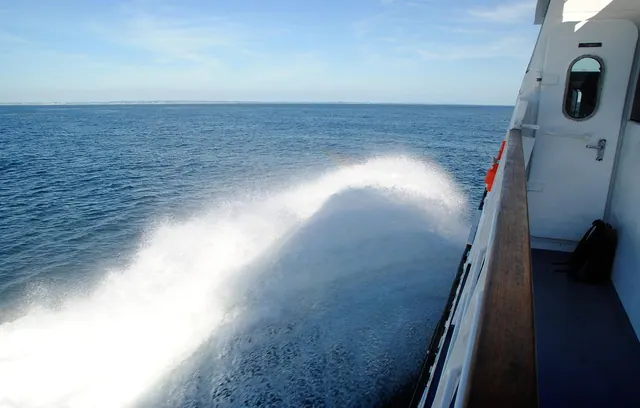
Wave behavior explains most of what happens to your frames. NOAA describes how waves work: waves are created by energy passing through water, causing it to move in a circular motion, and the water itself does not travel with the wave. Waves transmit energy rather than water, and if nothing obstructs them they can cross an entire ocean basin. Most are wind-driven surface waves, created by friction between wind and the water's surface.
This matters practically. A long swell arriving from a distant storm can be present on a calm, sunny day, producing a slow deep roll that ruins long exposures while looking like nothing in the frame. Local wind chop does the opposite: it looks dramatic and barely moves a large vessel.
Read significant wave height properly
Buoy reports use a specific term that is widely misread. The National Data Buoy Center explains that significant wave height is approximately equal to the average of the highest one-third of the waves, measured from trough to crest, and that it is derived from the variance of the wave displacement record through the nondirectional wave spectrum.
The key point for a passenger is that individual waves can be noticeably larger than the significant wave height, because the figure is an average of the largest third rather than a maximum. Treat it as a description of the sea state, not as a ceiling, and adjust what you plan to do on an open deck accordingly.
A working method for a crossing
Pick the rail before you sail, based on light direction. Set a shutter speed faster than feels necessary. Shoot the terminal and the departure, then put the camera away for ten minutes and actually look at the water so you know what the boat is doing. Come back for the approach, which is usually the best sequence of the crossing.
If the sea state is rough, stop. Rough water on an open deck is a safety matter rather than a photographic opportunity, and no frame is worth being unable to hold on. The wider set of trip errors is covered in our guide to avoiding ferry trip mistakes.
Common questions
Should I shoot in manual on a ferry? Aperture priority with a shutter speed floor is usually easier, because the light over water changes faster than you can adjust.
How do I keep salt off the front element? A hood, a cloth in a sealed bag, and not shooting into spray. Clean it before it dries.
Is a wet crossing worth shooting at all? Often the best ones are. Protect the gear, stay inboard, and shoot through glass if the deck is closed.
What should the rest of my kit look like? Minimal and carryable. Our field list for U.S. ferry crossings sets out what earns its place.