Features
Part of Five kinds of ferry route, told through the water each one crosses
Tide-timed natural features you can reach by ferry around the Bay of Fundy
Old Sow whirlpool, the Saint John Reversing Falls and Grand Manan, with the ferry operators, crossing times and tide timing that put each on a longer trip.
What to take away
- Three natural features around the Bay of Fundy have a ferry attached: Old Sow (Deer Island ferries), the Saint John Reversing Falls (the Digby to Saint John ferry) and the waters around Grand Manan.
- Old Sow, off the Maine and New Brunswick border, is the largest whirlpool in the Western Hemisphere, according to NOAA.
- Each feature runs on the tide, not the timetable. Work backwards from the predicted time.
- Sailings change by season, and fares move. Confirm both with the operator before you go.
Features are timed by water, not by opening hours
A cathedral opens at nine. A tidal feature happens when the water says so. That is the whole difference in planning a trip around one: you work backwards from a predicted time rather than forwards from a departure.
Check the feature's timing first, then find a sailing that matches, then book accommodation that lets you be there. Reversing the order almost never works.
Old Sow, reached by the Deer Island ferries
NOAA calls Old Sow the largest whirlpool in the Western Hemisphere.
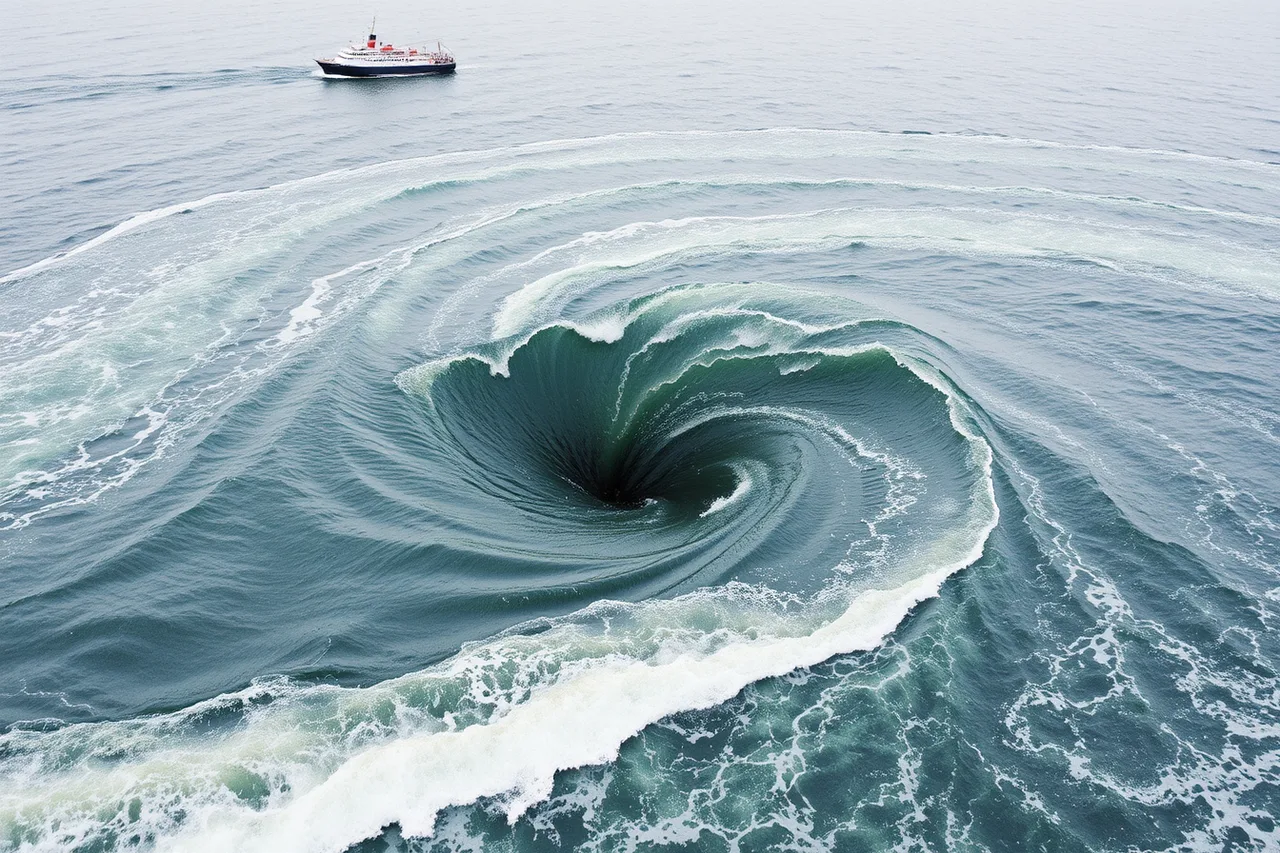
When the tide enters from the Bay of Fundy, between Maine and New Brunswick, a large volume of water flows swiftly into the confined Western Passage, then upriver into Passamaquoddy Bay. The flow turns sharply north, crosses a deep trench, passes an underwater mountain and meets several countercurrents. Part of it pinches into the whirlpool.
NOAA notes that its turbulent water can be dangerous to small-craft mariners. The same swirling motion drives upwelling, bringing nutrients and small sea creatures to the surface, which feeds resident fish and seabirds.
The ferry pieces
Old Sow lies off the southwestern shore of Deer Island, New Brunswick, and off the northeast shore of Moose Island, where Eastport, Maine sits. Two Deer Island ferries put you beside it.
- Campobello Island to Deer Island:operated by East Coast Ferries Ltd., about 20 minutes. Campobello is joined by the Franklin Delano Roosevelt Bridge to Lubec, Maine. A regional guide lists departures from Campobello on the hour from 9 a.m. to 7 p.m. and from Deer Island on the half hour from 8:30 a.m. to 6:30 p.m. in mid-June through September. New Brunswick announced an extended 2026 season with daily weather-permitting crossings until October 12, so by now the 2026 season has likely ended. Fares are collected on board; call East Coast Ferries at 506-747-2159 for 2027 dates.
- L'Etete to Deer Island:run by Coastal Transport Limited for the province, with no fare. The crossing is about 20 minutes over roughly 5 kilometers, year round, with departures every 30 minutes by day and hourly in the evening. Call 506-662-3724, or 511 in New Brunswick, for service interruptions.
We could not confirm a current Deer Island to Eastport passenger ferry, so do not plan around one. Crossing from Lubec to Campobello means a border stop, so check our guide to US Canada ferry customs first.
Timing the whirlpool
NOAA says the whirlpool is considered most visible and dangerous three hours after low tide, and the tidal range reaches about 19 feet at Eastport. Look up the predicted low water for Eastport and plan to be on the Deer Island side, or on a suitable vessel, around three hours later.
Small craft, sailboats and human-powered boats are warned to avoid these waters when the tide is running.
Saint John Reversing Falls, reached by the Digby ferry
The Reversing Falls are rapids in Saint John, New Brunswick, where the Bay of Fundy's tide forces the river to run upstream. They are a good reason to cross the Bay on the Bay Ferries service.
The MV Fundy Rose runs daily between Digby, Nova Scotia, and Saint John. Bay Ferries lists the crossing at just over two hours. A sample sailing listed for October 16, 2026 was 9:00 a.m. from Saint John and 4:00 p.m. from Digby, but the timetable changes, with a maintenance period listed for October 27 and 28. Bay Ferries publishes 2026 passenger and vehicle fares on its fares page, and reservations are on 1-877-762-7245.
Slack tide lasts about 20 minutes and is the only time boats can run the rapids. A Bay of Fundy tourism article gives a rule of thumb: add 3 hours and 50 minutes to low tide for low slack, and 2 hours and 25 minutes to high tide for high slack. Treat that as an estimate and check the day's tide table.
Viewing is from Fallsview Park or the Reversing Falls Rapids Tourist Centre, which has a rooftop platform. The best moving-water views come a few hours after low tide or soon after high tide, when the whirlpools and rapids run strongest.
Grand Manan, a ferry-first island
Grand Manan Island sits in the Bay of Fundy, and the crossing is the experience. Coastal Transport runs the Grand Manan Adventure between Blacks Harbour and North Head, a 32 kilometer route that takes about 90 minutes. Frommer's guide notes the boats have observation decks for watching for whales.
Crossing times and sailings are posted by the operator, and fares have changed over the years. Call 506-662-3724 for current prices.
A note on Stellwagen Bank
Stellwagen Bank National Marine Sanctuary covers about 842 square miles at the mouth of Massachusetts Bay, between Cape Cod and Cape Ann. Humpback, fin and minke whales visit every year. It is reached by whale-watch boats rather than scheduled crossings. The Dolphin Fleet, for example, runs three- to four-hour trips from Provincetown from April through October. Our guide to protected waters and working harbors covers more of these.
Fitting a feature into a longer trip
Give a tide-timed feature its own half day and treat everything else that day as flexible. Then keep a fallback nearby, because features and cancelations are driven by the same weather. Our rescue stops article, "Sheltered stops that rescue a ferry day when plans fall apart", covers those, and the route archetypes are in our ferry route types guide, "Five kinds of ferry route, told through the water each one crosses".